Can ChatGPT Write a Workmanship Warranty for My Business?
ChatGPT can turn how you already handle callbacks into a clear, customer-friendly workmanship warranty. It shouldn't decide how long you cover the work, what's excluded or how your state treats warranties. Five copy-paste prompts that keep those decisions yours.
Yes, ChatGPT (or Claude, or Gemini) can draft a workmanship warranty for you. It’s good at turning “we come back and fix it free if our install fails in the first year” into clear sections a customer understands: what’s covered, for how long, what isn’t, and how to make a claim. What it shouldn’t do is decide your warranty length, your exclusions or your legal terms, because it doesn’t know your costs, your callback history or your state’s rules. You set those, and a lawyer licensed in your state reviews the final version.
A written warranty is a promise you’ll be held to. The goal isn’t fancy wording. It’s a document that says exactly what you already do, in words that won’t surprise anyone later.
This guide gives you five copy-paste prompts, from your own notes to a finished warranty, a customer-friendly summary and a claims checklist for your office. Every prompt tells the AI to leave lengths, dollar amounts and legal terms as [BRACKETS] for you to fill in. The examples cover HVAC, plumbing, electrical, roofing, remodeling and landscaping, but the method works for any trade.
Before you use any warranty: this article is not legal advice. Warranty rules vary by state and by what you sell, and some trades have licensing-board rules too. Have a lawyer licensed in your state review your warranty before you hand it to a customer, and paste their wording in word for word.
Workmanship warranty vs manufacturer warranty
These get mixed up all the time, by customers and by AI.
- Your workmanship (labor) warranty covers the quality of your work: the install, the connections, the flashing, the repair. It’s your promise, on your terms.
- The manufacturer’s warranty covers the equipment or materials: the condenser, the water heater, the shingles. It’s the manufacturer’s promise, on their terms, and it may require registration or proper installation.
Your document should say clearly which is which, and that you’ll help with manufacturer claims without promising what the manufacturer will do.
There’s also a federal angle when parts are involved. The FTC’s rules under the Magnuson-Moss Warranty Act say warranties that apply solely to a repairer’s workmanship aren’t covered by the Act, but where a written agreement warrants both the parts and the workmanship, the warranty must comply with it. The same rules bring separate equipment attached to a home, like air conditioners, furnaces and water heaters, under the Act (16 CFR 700.1). That’s one more reason the lawyer review isn’t optional, especially if you install equipment and warrant it.
What AI should and shouldn’t do on a warranty
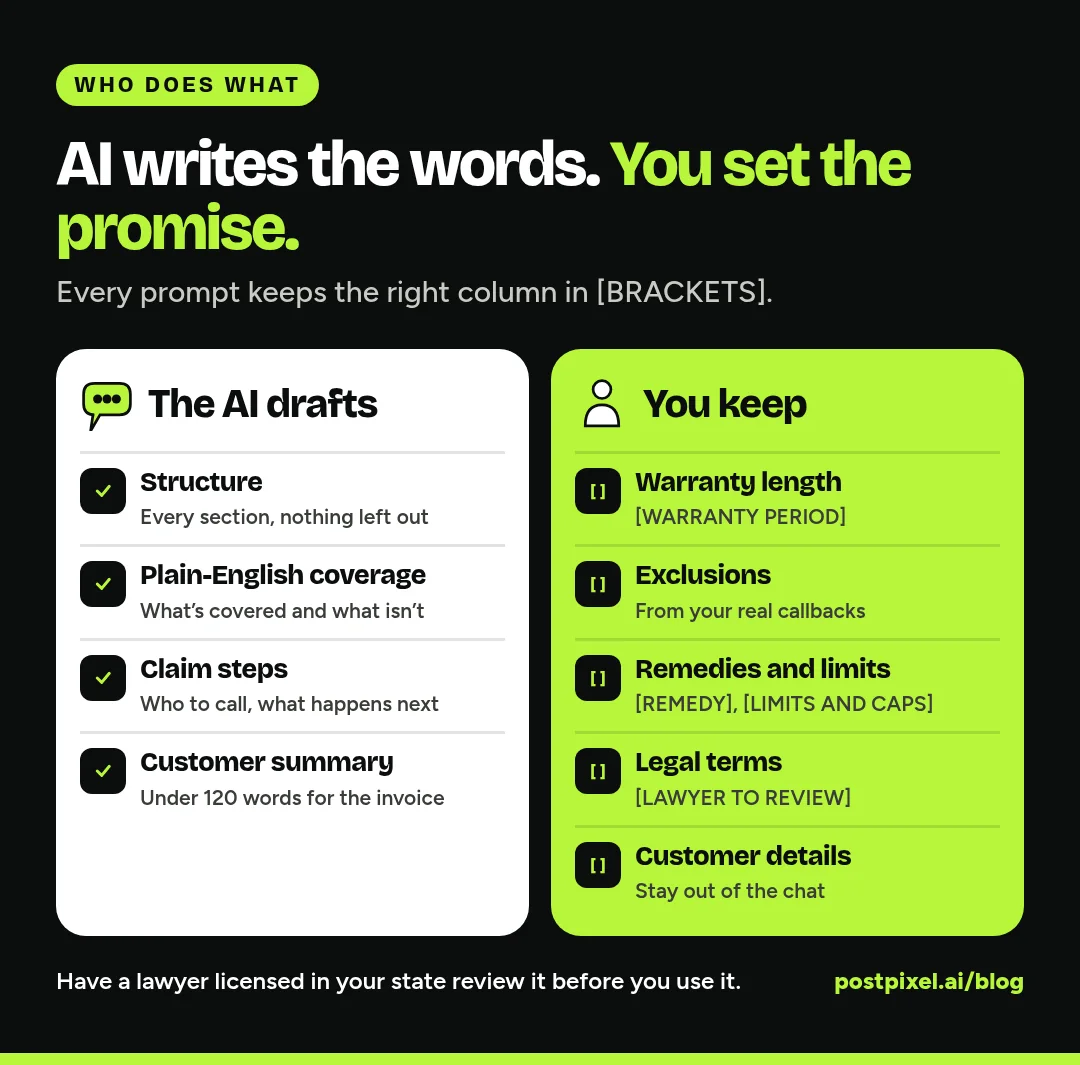
The AI can draft:
- The structure, so nothing gets left out
- Plain-English wording for what’s covered and what isn’t
- Simple steps for making a claim
- A short summary for the customer and a claims checklist for your office
You keep:
- The warranty length. One year, two years, lifetime of ownership: that’s a business decision. The AI writes [WARRANTY PERIOD].
- Exclusions. Based on your real callbacks, not a generic list. The AI suggests, you decide.
- Remedies and limits. Repair, redo or refund, caps, who pays for access and finish work. All [BRACKETS].
- Legal terms. Disclaimers, limits on liability, transfer rules, dispute terms. Marked [LAWYER TO REVIEW].
- Customer details. Names, addresses and payment details stay out of the chat. Use [CUSTOMER NAME] and [JOB ADDRESS].
The five prompts
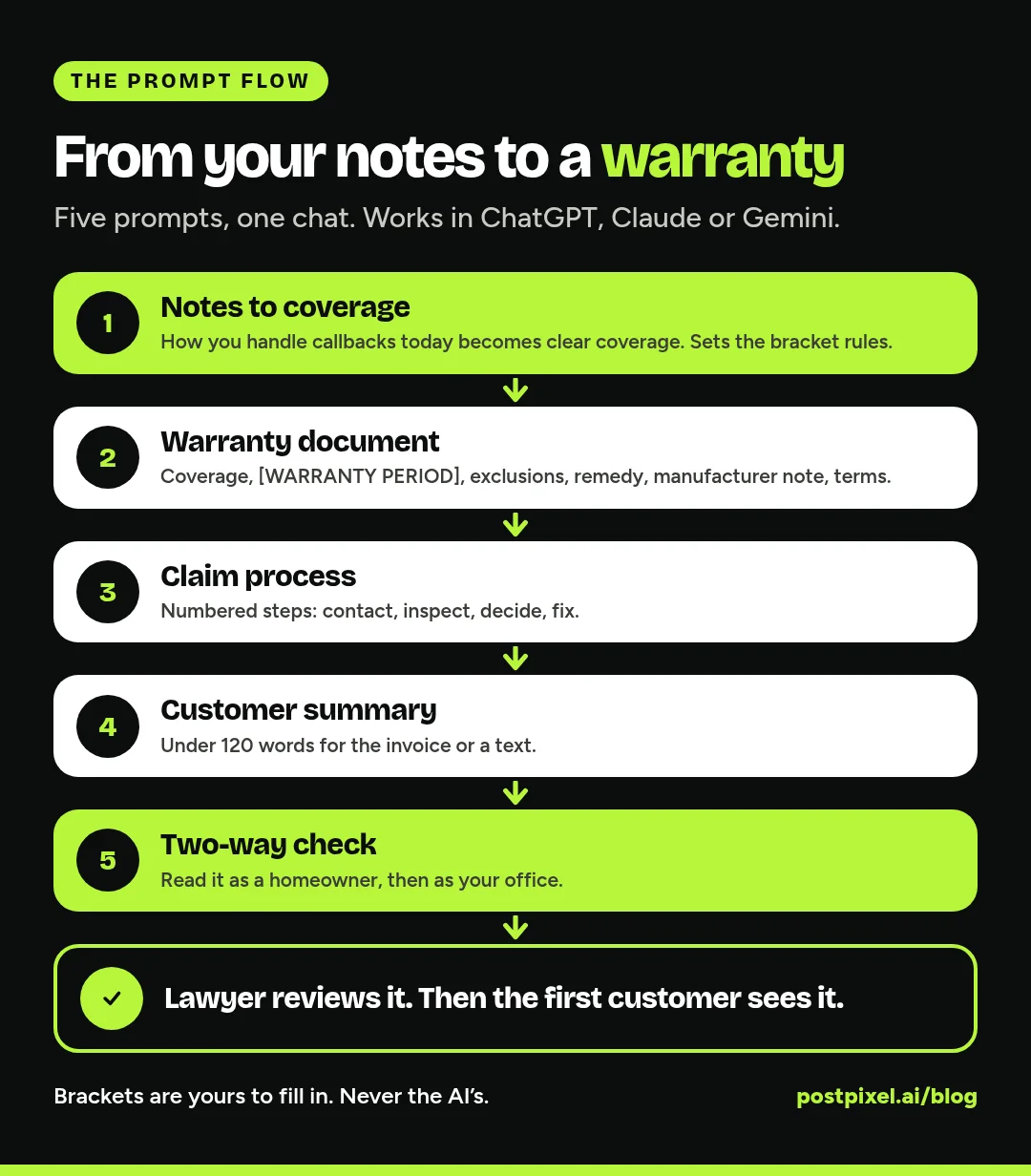
Run these in one chat so the AI keeps the context. Copy a prompt, fill in the [BRACKETED] parts that are yours, and paste it in. If the AI gets something wrong, say so plainly (“we don’t cover drywall patching, take that out”).
Prompt 1: Set the rules and turn your notes into coverage
This sets the guardrails for the whole chat. The notes part matters most: describe how you actually handle problems today.
I own a [TRADE, e.g. HVAC / plumbing / electrical / roofing / remodeling / landscaping] company in [STATE].
I want a written workmanship (labor) warranty for [TYPE OF WORK, e.g. "residential system installs" / "repair calls" / "full roof replacements"].

Rules for this whole conversation:
- Never choose a warranty length, dollar amount, cap or deadline. Leave every one as a [BRACKETED PLACEHOLDER].
- Never write disclaimers, limits of liability, implied-warranty language, transfer rules or dispute terms as final. Mark them [LAWYER TO REVIEW].
- Never promise anything on behalf of an equipment or materials manufacturer. Use [MANUFACTURER WARRANTY: SEE MANUFACTURER TERMS].
- Never state code, permit or licensing requirements as fact. Mark them [CHECK LOCAL RULES].
- Use [COMPANY NAME], [CUSTOMER NAME] and [JOB ADDRESS]. Don't ask me for real customer details.
- Plain, friendly language a homeowner understands.

Here's how we handle problems with our work today, in my own words:
[PASTE YOUR NOTES, e.g. "if a fitting we installed leaks in the first year we fix it free. we don't cover stuff the customer or another company touched. we don't pay for drywall or paint after."]

Write:
1. A one-sentence summary of what we stand behind.
2. A list of what's covered, in plain words.
3. A list of things you'd expect us to exclude, based on my notes, each marked SUGGESTED so I can accept or delete it.
If anything in my notes is unclear, ask me before guessing.
Read the suggested exclusions slowly. Delete anything you don’t actually exclude, because a warranty that’s stingier than how you really treat customers will cost you trust.
Prompt 2: Build the warranty document
Now turn that into a one-page workmanship warranty with these sections:
- Header: [COMPANY NAME], [LICENSE NUMBER IF REQUIRED], warranty for [TYPE OF WORK], job date [COMPLETION DATE], [CUSTOMER NAME], [JOB ADDRESS]
- What this warranty covers (from above)
- How long it lasts: [WARRANTY PERIOD], starting [START EVENT, e.g. completion date / final inspection]
- What's not covered (only the exclusions I kept)
- What we'll do if there's a covered problem: [REMEDY, e.g. repair or redo the work], at no charge for [LABOR / PARTS / BOTH]
- Limits: [LIMITS AND CAPS, LAWYER TO REVIEW]
- Manufacturer warranties: a short paragraph saying equipment and materials are covered by the manufacturer's own terms, and that we'll help with the claim process [DESCRIBE WHAT HELP YOU OFFER]
- Conditions: [CONDITIONS, e.g. maintenance required, payment in full, LAWYER TO REVIEW]
- Transfer to a new owner: [TRANSFER TERMS, LAWYER TO REVIEW]
- How to make a claim (leave as a heading, we'll write it next)
- Legal terms: [LAWYER-APPROVED WARRANTY TERMS, PASTE AS-IS]
Keep it to one page. Don't add any promises or terms I didn't give you.
Prompt 3: The claim process
Most warranty frustration comes from not knowing what to do. Spell it out.
Write the "How to make a claim" section. Include:
- How to contact us: [PHONE / EMAIL / FORM]
- What to tell us: what's happening, when it started, the job date or invoice number
- How soon we'll respond: [RESPONSE TIME]
- What happens next: we inspect, tell the customer whether it's covered and why, and schedule the fix
- What the customer should do in the meantime for safety (e.g. shut off water or power if there's a leak or sparking) and to call an emergency service for anything dangerous
- That they shouldn't let anyone else work on it first, if that's one of my exclusions: [YES / NO]
Short, numbered steps. No legal language.
Prompt 4: The customer summary
Customers don’t read a full warranty at the kitchen table. Give them the short version too.
Write a customer-friendly summary of this warranty, under 120 words, to print on the back of the invoice or send by text or email after the job.
- What's covered and for how long ([WARRANTY PERIOD])
- The two or three biggest exclusions
- How to make a claim
- A line saying the full warranty terms are attached and apply
No exclamation marks, no sales language, and no promise that isn't in the full warranty.
Prompt 5: Check it like a customer (and like your office)
Once you’ve filled in the brackets and pasted your lawyer’s terms, paste the finished warranty back in, still with placeholders for customer details, and run:
Read this warranty twice.
First, as a homeowner: list anything unclear, anything that sounds like a bigger promise than it is, and questions you'd ask before relying on it.
Second, as our office manager: write a short checklist for handling a claim under this warranty (what to ask on the phone, what to check in the job record, what photos to take, how to log the decision).
Don't change any lengths, amounts or legal terms. Just point out problems so I can fix them.
Tweaks by trade
Add a line of trade context to Prompt 1 and the drafts get sharper.
HVAC
Separate your labor on the install from the equipment’s manufacturer warranty, and ask the AI to note that registration may be required by the manufacturer, as a [CHECK MANUFACTURER TERMS] bracket. If your coverage depends on regular maintenance, say so in Conditions and link it to your maintenance plan. Our service and maintenance agreement prompts use the same bracket rules.
Plumbing
Name what you installed (fittings, connections, fixtures you set) and exclude what you didn’t touch. Water damage and access are the big questions: who pays to open and close walls is a [REMEDY] decision for you and your lawyer, not the AI.
Electrical
Keep code items as [CHECK LOCAL RULES] and avoid any language that sounds like you’re certifying the whole house. Exclude existing wiring you didn’t work on, if that’s how you operate.
Roofing
Roofing warranties get confusing fast, because shingle manufacturers often offer their own system warranties. Ask the AI to keep your workmanship coverage (flashing, fastening, leaks from your install) separate from anything the manufacturer offers, and to never name a manufacturer warranty tier unless you paste its terms.
Remodeling
List the trades and finishes you did. Cosmetic issues like settling cracks, grout color and wood movement are common exclusions, but only keep the ones that match how you really handle callbacks.
Landscaping
Plant warranties are their own thing: survival periods, watering responsibilities and acts of nature. Keep every period as [PLANT WARRANTY PERIOD] and put the customer’s watering responsibilities in Conditions.
Mistakes to avoid
- Letting the AI pick the length. If a number appears that you didn’t type, delete it and put the bracket back.
- Promising for the manufacturer. Point to their terms. Don’t restate them.
- Generic exclusions. A long list copied from the internet reads as a warranty designed to never pay. Keep it honest.
- Skipping the claim steps. A warranty with no clear way to claim it creates angry phone calls.
- Pasting real customer details. Templates only. Names, addresses and payment details stay in your own software.
- Skipping the lawyer. Warranty language affects what you owe customers for years. Have a lawyer licensed in your state review it once, then reuse it.
Putting it to work
- Save one template per job type. An install warranty and a repair warranty usually differ.
- Store it in your field service software. Many tools let you attach terms to estimates and invoices, so the warranty goes out with every job. If you’re choosing software, our Housecall Pro vs Jobber comparison is a starting point.
- Train your office. The claims checklist from Prompt 5 is your phone script.
- Review it once a year. Look at last year’s callbacks and adjust exclusions and lengths with your lawyer.
FAQ
Can ChatGPT write a workmanship warranty?
Yes, for the structure and plain-English wording: what’s covered, exclusions, claim steps and a customer summary. You decide the length, exclusions, remedies and limits, and a lawyer licensed in your state should review it before you use it.
What should a workmanship warranty include?
Usually: your company details, the work covered, how long it lasts and when it starts, what’s not covered, what you’ll do if there’s a covered problem, limits and conditions, how manufacturer warranties fit in, transfer terms, how to make a claim, and lawyer-approved legal terms.
What’s the difference between a workmanship warranty and a manufacturer warranty?
Your workmanship warranty covers the quality of your labor. The manufacturer’s warranty covers the equipment or materials. Keep them separate in writing, and don’t promise what the manufacturer will do.
Does federal warranty law apply to a workmanship warranty?
The FTC’s interpretation (16 CFR 700.1) says warranties that apply solely to a repairer’s workmanship aren’t covered by the Magnuson-Moss Warranty Act, but a written warranty that covers both parts and workmanship must comply. State law can still apply either way. Ask your lawyer.
Is it safe to put customer information into ChatGPT?
Keep it out. Use placeholders like [CUSTOMER NAME] and [JOB ADDRESS] in the chat, and fill in real details in your own software. Never paste payment details into any AI chat.
One more thing
When the job’s done and the warranty’s in the customer’s hands, PostPixel makes it easy to share the finished work in a branded post. Start free.