Post Pixel vs Canva vs Marketing Agencies: The Honest Comparison
Tutorials & Tips
20 Min Read
Home service businesses often face a tough choice: spend hours designing posts on Canva or pay high agency fees. PostPixel solves both by auto-generating, branding, and scheduling a month of social media content in minutes. No design skills, no contracts just faster, affordable, hands-free marketing built specifically for service businesses.
Join our newsletter list
Sign up to get the most recent blog articles in your email every week.
If you run a home service business, a contracting company, or any kind of local service operation, you have probably faced the same marketing decision at some point. As your business grows, you eventually realize that visibility online matters. Customers search for companies on Google, they check reviews, and they often look at social media before deciding who to call.
At that moment, a practical question appears: how should you handle your marketing?
Many business owners begin by considering three common options. The first option is to handle marketing themselves using tools like Canva. The second option is hiring a marketing agency to manage everything professionally. The third option is using a system like Post Pixel that automates content creation and scheduling.
All three options can work. Each one has strengths and weaknesses, and the right choice depends on factors such as the stage of your business, how much time you have available, how much budget you are willing to invest, and how much complexity you are comfortable managing.
Instead of presenting a sales pitch or exaggerating benefits, this guide offers an honest comparison of these three approaches. Understanding the differences can help business owners choose a strategy that fits both their time and their long-term goals.
Option One: Canva and the DIY Marketing Approach
For many small business owners, Canva is often the first tool they encounter when they begin marketing their company online. Canva has become extremely popular because it allows people with little design experience to create graphics quickly. With thousands of templates, simple drag-and-drop editing, and easy export options, it makes design accessible to almost anyone.
From a design perspective, Canva is an excellent tool. It allows users to create social media posts, flyers, advertisements, and other visual content without needing professional graphic design skills. For entrepreneurs who are just starting their businesses, this accessibility can feel empowering. Suddenly, creating professional-looking content seems possible without hiring a designer.
However, there is an important distinction that many business owners overlook.
Canva is a design tool, not a marketing system.
Design is only one small part of marketing. While Canva helps create visuals, it does not tell you what to post, when to post, or how to build a consistent strategy that keeps your business visible over time. It also does not automatically generate captions, plan content calendars, or maintain a consistent publishing rhythm.
In other words, Canva provides tools for creating individual pieces of content, but it does not manage the marketing process itself.
The Hidden Cost of DIY Marketing
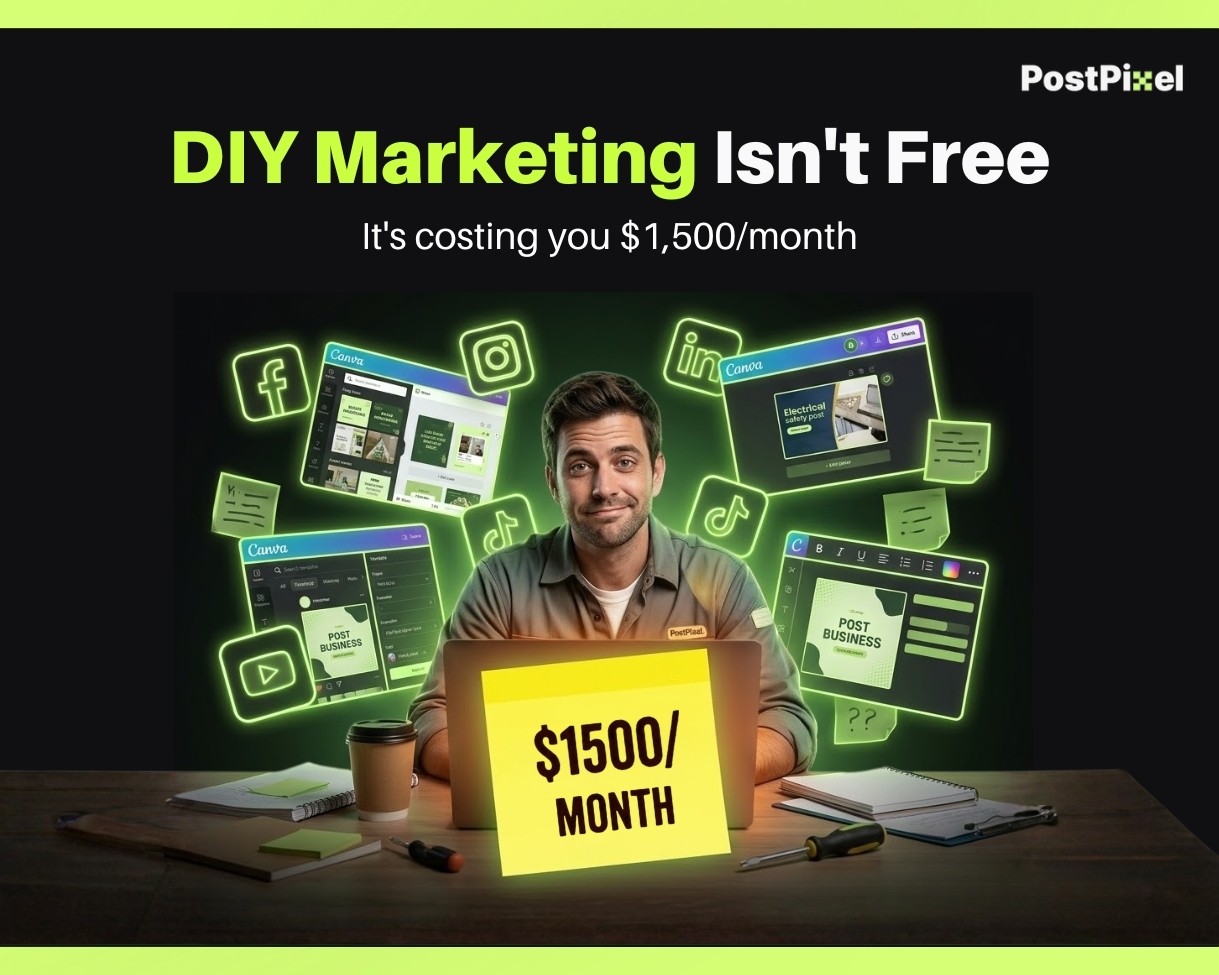
Because Canva’s subscription is relatively inexpensive, many business owners assume that doing marketing themselves is the most affordable option. However, the real cost of DIY marketing is rarely the price of the software. The real cost is the time required to use it.
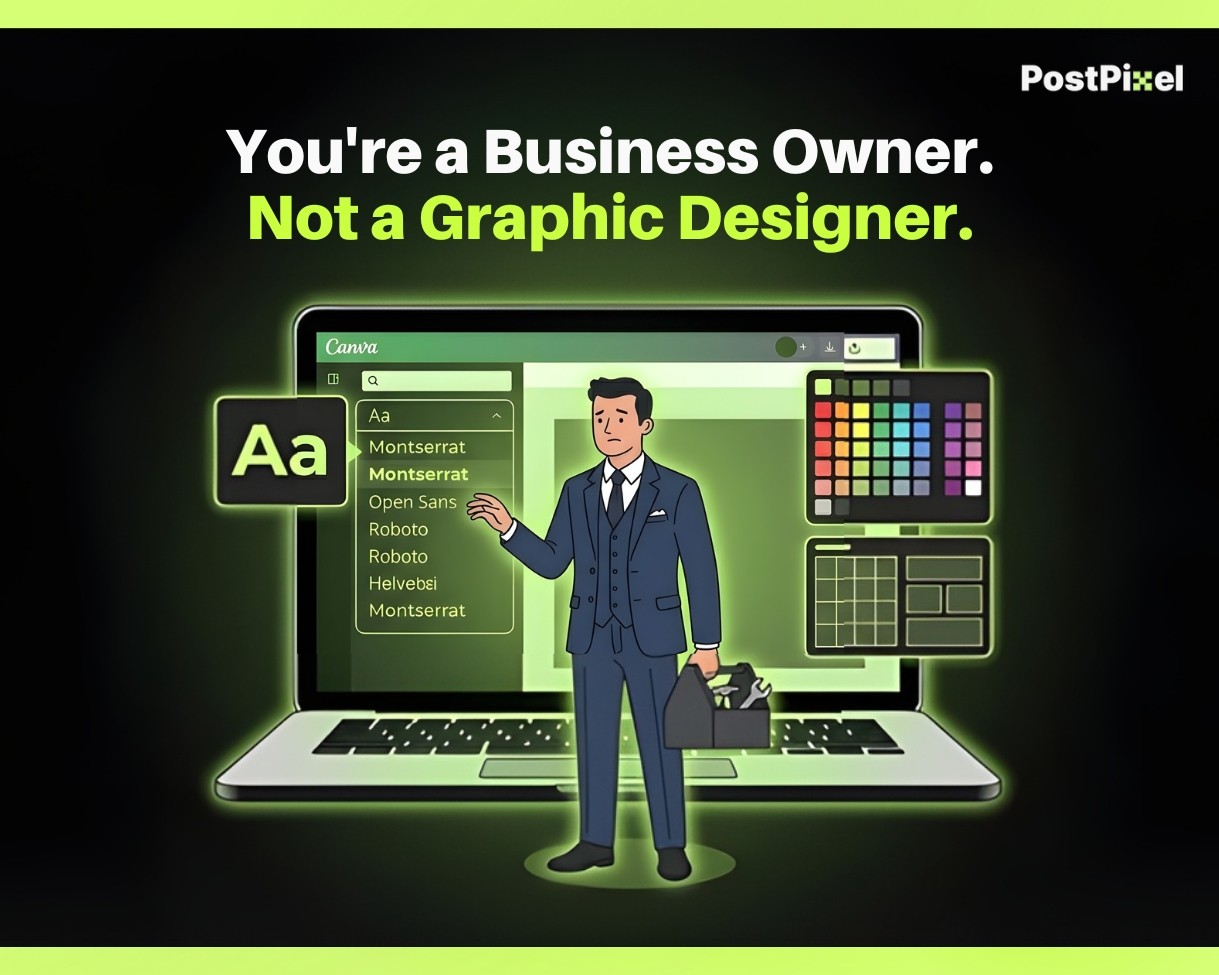
Creating social media content manually involves far more steps than most people initially expect. Business owners must brainstorm ideas, search for images, design layouts, experiment with fonts and colors, write captions, choose hashtags, resize images for different platforms, and schedule posts.
Each individual step may seem small, but together they require hours of attention every month.
For many business owners, the time commitment falls somewhere between four and twelve hours per month. In some cases it can be even higher, especially if the owner wants the posts to look polished or professional.
If the business owner values their time at roughly one hundred dollars per hour, those hours represent an opportunity cost of four hundred to twelve hundred dollars every month.
That hidden cost rarely appears on an invoice, but it still exists. In addition to the financial impact, DIY marketing also creates mental pressure. Business owners must constantly think about what to post next, worry about maintaining consistency, and find time for marketing tasks during already busy schedules.
Over time, this mental load can lead to creative fatigue and burnout.
The Canva subscription may be inexpensive, but the time required to operate it is not.
When Canva Actually Makes Sense
Despite these limitations, Canva can still be a useful tool in certain situations. For very early-stage businesses or solopreneurs who have more time than money, DIY marketing may be a reasonable starting point. Entrepreneurs who enjoy design work or experimenting with creative content may even find the process rewarding.
In these situations, the trade-off between time and cost can be acceptable.
However, as businesses grow, the equation begins to change. When schedules become full and operational responsibilities increase, the hours required for DIY marketing become more difficult to justify.
Busy contractors, service technicians, and small business owners often reach a point where they simply cannot maintain consistent marketing while running daily operations.
At that stage, many begin looking for alternatives.
Option Two: Hiring a Marketing Agency
The most traditional alternative to DIY marketing is hiring a marketing agency. Agencies typically offer a range of services that include strategy development, branding guidance, social media content creation, advertising campaigns, and marketing analytics.
Working with a professional agency can provide clear advantages. Experienced marketing teams bring knowledge of industry trends, content strategies, and advertising techniques that individual business owners may not have time to learn themselves. Agencies can also manage the entire marketing process, from planning content calendars to publishing posts and analyzing performance data.
For companies that want a completely hands-off solution, agencies can deliver valuable expertise and creative direction.
However, these benefits usually come with a significant financial commitment.
The Real Cost of Marketing Agencies
Social media management services from marketing agencies typically cost between $1,200 and $2,500 per month. Some agencies charge even more depending on the level of service provided. Over the course of a year, this can represent a marketing investment of $14,000 to $30,000 or more.
For larger companies with multiple locations or high profit margins, this level of investment may be reasonable. Agencies can help manage complex marketing strategies and scale campaigns across multiple markets.
However, for many small or mid-sized home service businesses, the cost of a full agency partnership can feel excessive.
By comparison, tools like PostPixel are priced more like software than services. Instead of a multi-thousand-dollar retainer, you pay a predictable monthly subscription that usually comes in far below an agency fee and below the hidden time cost of trying to do everything yourself
In addition to financial cost, working with agencies also introduces operational friction. Businesses often need to attend strategy meetings, review content drafts, approve revisions, and communicate regularly with account managers. These processes can slow down execution and create additional coordination work.
Agencies also work with multiple clients at once. While they strive to provide quality service to each client, your business is rarely their only priority.
Where Agencies Struggle With Local Service Businesses
Another challenge agencies sometimes face is understanding the nuances of specific trades. A marketing team that works with a variety of industries may not fully understand the details of plumbing repairs, HVAC installations, or electrical troubleshooting.
Because of this, agencies may rely on stock photos or generic messaging that does not accurately reflect the real work performed by the business. Capturing authentic field content can also be difficult when the marketing team is not physically present on job sites.
Local service businesses move quickly, and marketing decisions often need to happen just as quickly. Agencies, however, typically operate on structured timelines and approval processes that may not always match the pace of a growing service company.
For some businesses, this mismatch can create frustration.
Option Three: The Systemized Automation Model
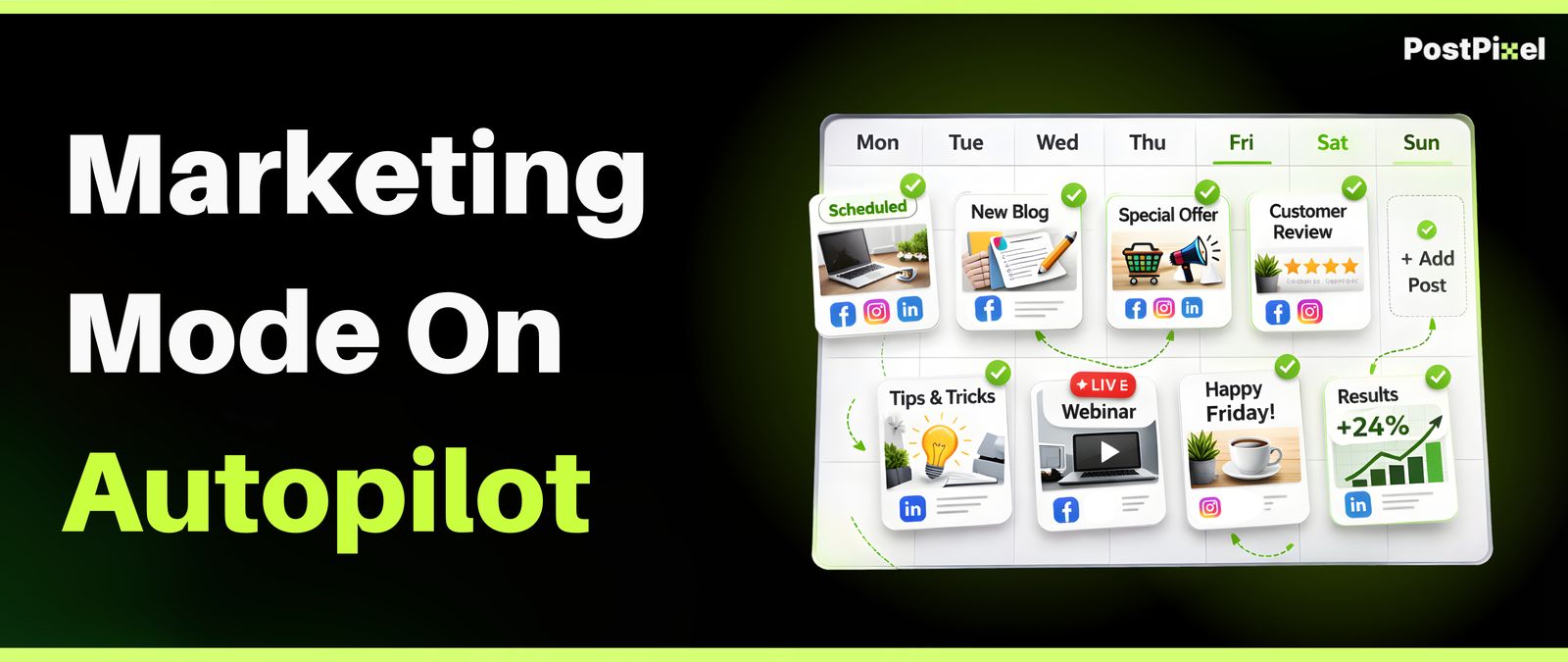
Between DIY marketing and full agency management lies a third option that has become increasingly popular in recent years: systemized marketing automation.
Tools like Post Pixel are designed to operate differently from traditional design software or agency services. Instead of requiring constant manual work or large monthly retainers, these systems focus on automating repetitive marketing tasks.
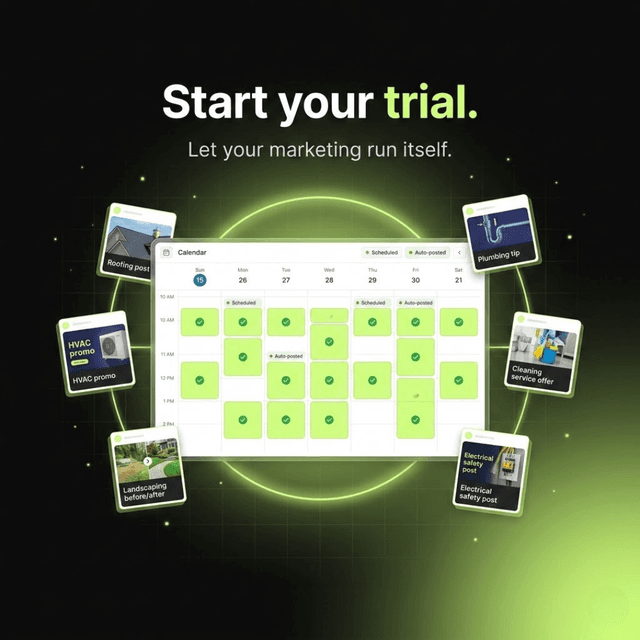
Post Pixel works by analyzing a business’s website and services, generating industry-specific content ideas, designing branded social media posts, and scheduling them automatically.
Rather than asking the business owner to decide what to post every week, the system handles much of the process in the background.
The business owner’s role becomes much simpler: review the content and allow the system to publish it consistently.
The Value of Marketing Infrastructure
What makes automation tools powerful is that they function as infrastructure rather than individual tools.
Instead of solving only one part of the marketing process, they handle several steps simultaneously. Content ideas, design consistency, scheduling rhythm, and branding alignment all become part of a single system.
This structure removes much of the repetition that makes DIY marketing exhausting.
It also gives you a repeatable marketing engine you can rely on every week, instead of restarting the process from zero every time you need new posts.
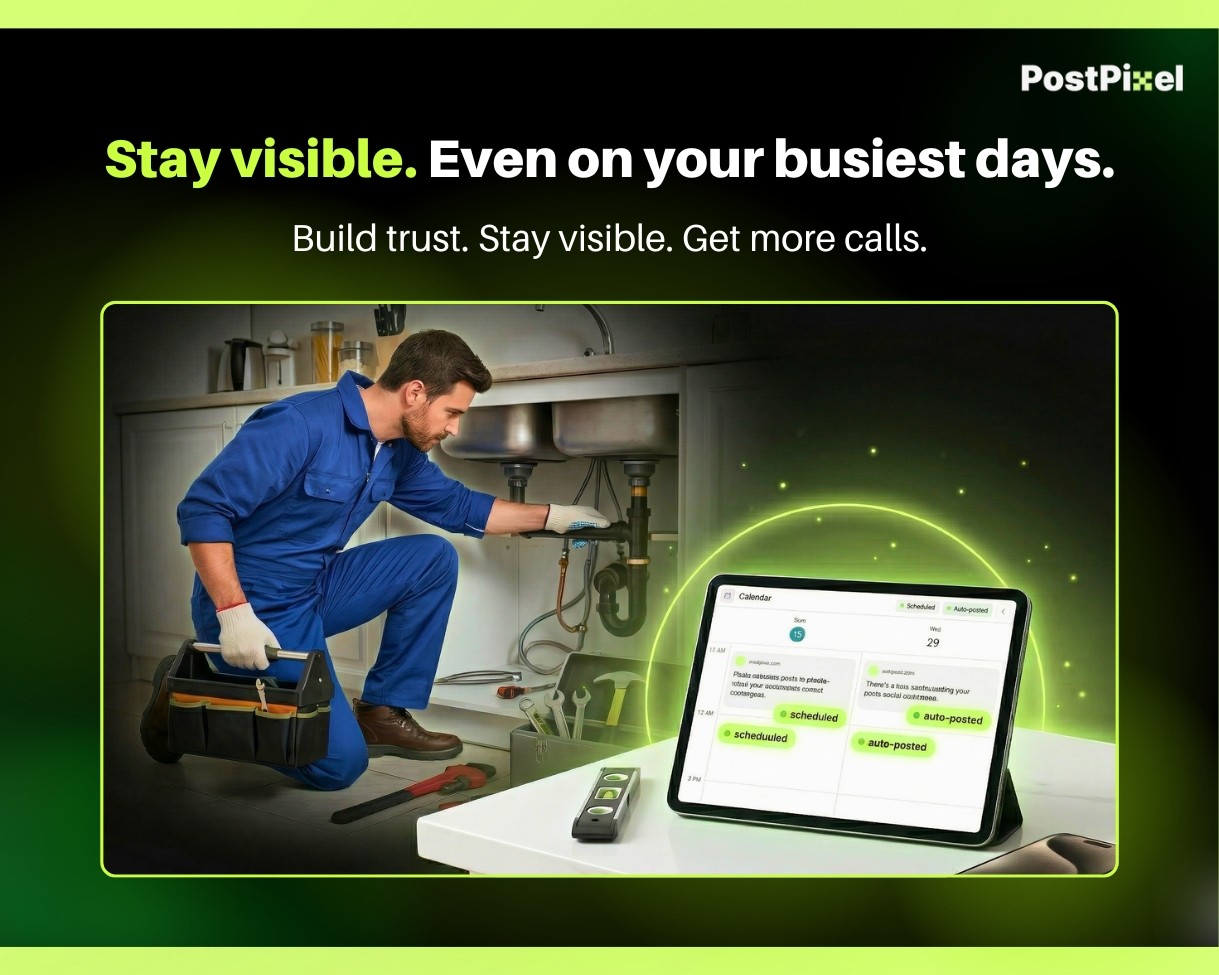
For busy business owners, the most valuable benefit is time protection. Instead of spending evenings designing graphics or writing captions, they can focus on serving customers, managing teams, and growing the company.
Marketing continues running in the background while the business operates normally.
The Time Equation for Business Owners
Time is one of the most limited resources for entrepreneurs. When comparing marketing options, the amount of time required often becomes more important than the cost of the software itself.
DIY marketing typically requires six to ten hours of work each month. Hiring an agency reduces this workload but still requires regular communication, approvals, and coordination. Automation systems reduce the time commitment even further, often requiring only minutes each week to review content.
For contractors and service business owners who are already operating at capacity, this difference can be significant.
In many cases, the real value of automation lies in protecting the owner’s schedule.
The Role of Leverage in Business Growth
From a business perspective, these three approaches represent different levels of leverage.
Manual marketing through DIY tools relies entirely on the owner’s time and energy. Delegating marketing to an agency transfers the workload to an external team but increases financial cost. Systemized marketing automation attempts to balance both factors by reducing manual effort while maintaining affordability.
Each level of leverage serves a different stage of business growth.
Early-stage businesses may rely on DIY tools because budgets are limited. Larger companies with aggressive growth strategies may benefit from agency partnerships. Many small to mid-sized service businesses, however, fall somewhere in the middle. They need consistent marketing but cannot justify the expense of a full agency team.
Automation systems often fill this gap.
The Bottom Line
Canva, marketing agencies, and automated systems like Post Pixel each serve different roles within the marketing ecosystem.
Canva is a tool that allows business owners to design content manually. Agencies provide professional services and strategic support. Post Pixel functions as a system that automates much of the marketing process.
None of these options is inherently wrong. The right choice depends on the needs, resources, and priorities of the business.
However, one pattern appears consistently across growing service companies.
Businesses rarely fail because they lack creativity.
They struggle because they lack consistent visibility.
Consistency requires structure, and structure often requires systems.
Final Thought
For most contractors and home service business owners, the real decision is not about design quality or marketing trends. It is about leverage.
DIY marketing consumes time. Agencies consume budget. Systems aim to protect both.
If maintaining consistent visibility without sacrificing time or spending thousands per month is important to your business, automation may provide the balance many companies are searching for.
Marketing should support the business, not compete with it.
And the right system allows it to run quietly in the background while you focus on the work that matters most.
See how PostPixel works with your own business. Start a free trial, connect your website, and watch it build a month of branded content for you so your marketing can finally run in the background while you get back to the jobs that actually pay the bills.